
CARACTERIZACIÓN DE PACIENTES CON DENGUE EN UN SERVICIO DE PEDIATRÍA
https://doi.org/10.56274/rcs.2025.4.2.61
Palabras clave:
Dengue; Pediatría; Epidemiología.Resumen
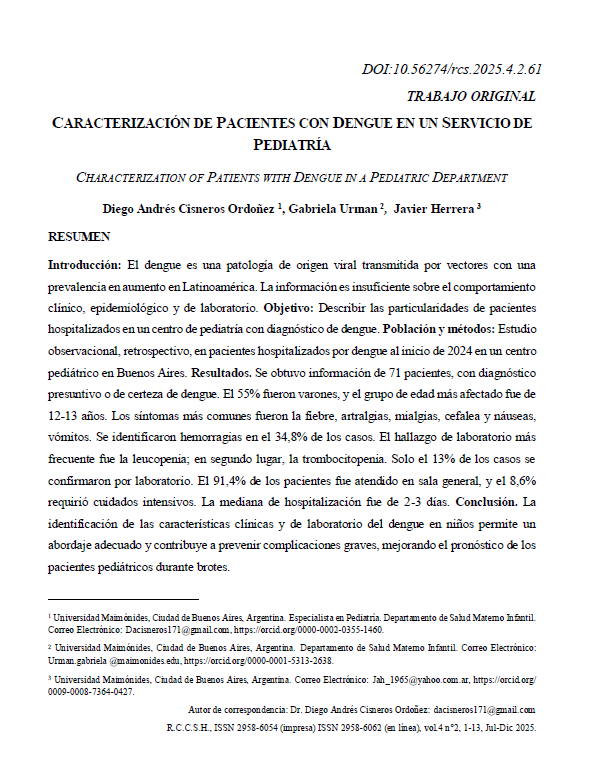
Introducción: El dengue es una patología de origen viral transmitida por vectores con una prevalencia en aumento en Latinoamérica. La información es insuficiente sobre el comportamiento clínico, epidemiológico y de laboratorio. Objetivo: Describir las particularidades de pacientes hospitalizados en un centro de pediatría con diagnóstico de dengue. Población y métodos: Estudio observacional, retrospectivo, en pacientes hospitalizados por dengue al inicio de 2024 en un centro pediátrico en Buenos Aires. Resultados. Se obtuvo información de 71 pacientes, con diagnóstico presuntivo o de certeza de dengue. El 55% fueron varones, y el grupo de edad más afectado fue de 12-13 años. Los síntomas más comunes fueron la fiebre, artralgias, mialgias, cefalea y náuseas, vómitos. Se identificaron hemorragias en el 34,8% de los casos. El hallazgo de laboratorio más frecuente fue la leucopenia; en segundo lugar, la trombocitopenia. Solo el 13% de los casos se confirmaron por laboratorio. El 91,4% de los pacientes fue atendido en sala general, y el 8,6% requirió cuidados intensivos. La mediana de hospitalización fue de 2-3 días. Conclusión. La identificación de las características clínicas y de laboratorio del dengue en niños permite un abordaje adecuado y contribuye a prevenir complicaciones graves, mejorando el pronóstico de los pacientes pediátricos durante brotes.
Descargas
Descargas
Publicado
Cómo citar
Número
Sección
Licencia
Derechos de autor 2025 Revista Científica en Ciencias de la Salud Humana – RCCSH

Esta obra está bajo una licencia internacional Creative Commons Atribución-NoComercial-CompartirIgual 4.0.

