
UNA VISIÓN ESTADÍSTICA IMPLICATIVA APLICADA AL BAJO PESO AL NACER
https://doi.org/10.56274/rcs.2025.4.2.56
Palabras clave:
Bajo peso al nacer, Factores de riesgo, Modo implicativoResumen
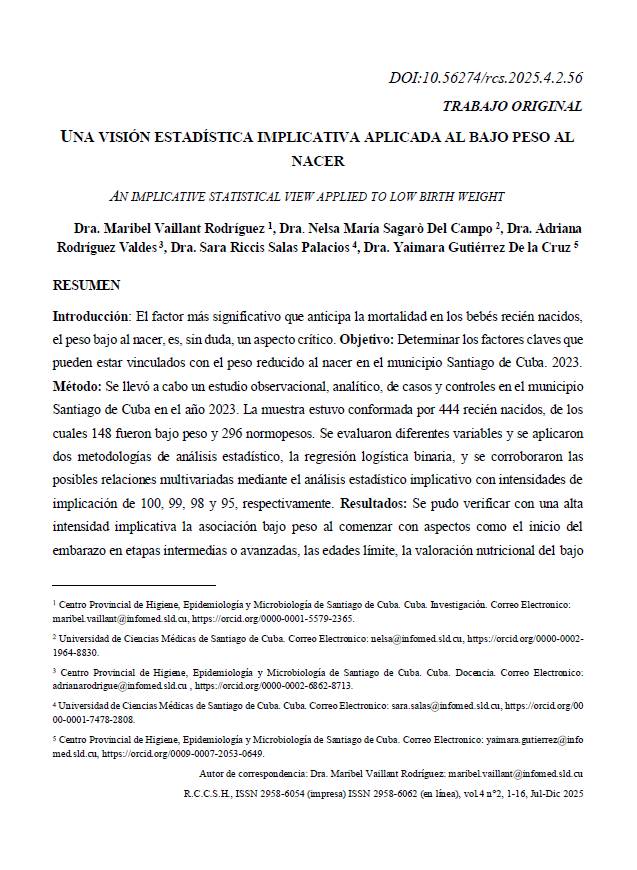
Introducción: El factor más significativo que anticipa la mortalidad en los bebés recién nacidos, el peso bajo al nacer, es, sin duda, un aspecto crítico. Objetivo: Determinar los factores claves que pueden estar vinculados con el peso reducido al nacer en el municipio Santiago de Cuba. 2023. Método: Se llevó a cabo un estudio observacional, analítico, de casos y controles en el municipio Santiago de Cuba en el año 2023. La muestra estuvo conformada por 444 recién nacidos, de los cuales 148 fueron bajo peso y 296 normopesos. Se evaluaron diferentes variables y se aplicaron dos metodologías de análisis estadístico, la regresión logística binaria, y se corroboraron las posibles relaciones multivariadas mediante el análisis estadístico implicativo con intensidades de implicación de 100, 99, 98 y 95, respectivamente. Resultados: Se pudo verificar con una alta intensidad implicativa la asociación bajo peso al comenzar con aspectos como el inicio del embarazo en etapas intermedias o avanzadas, las edades límite, la valoración nutricional del bajo peso materno. La presencia de infecciones vaginales durante el embarazo, antecedentes de hipertensión, anemia y el consumo de sustancias perjudiciales como tabaco, alcohol y café podrían ser vistos como posibles factores de riesgo en la población analizada. Conclusiones: El bajo peso al nacer es un desafío de salud a nivel global; los hábitos nocivos, el bajo peso materno, así como antecedentes personales y obstétricos podrían estar conectados, sin que esto difiera de las cifras a nivel mundial.
Descargas
Descargas
Publicado
Cómo citar
Número
Sección
Licencia
Derechos de autor 2025 Revista Científica en Ciencias de la Salud Humana – RCCSH

Esta obra está bajo una licencia internacional Creative Commons Atribución-NoComercial-CompartirIgual 4.0.

