
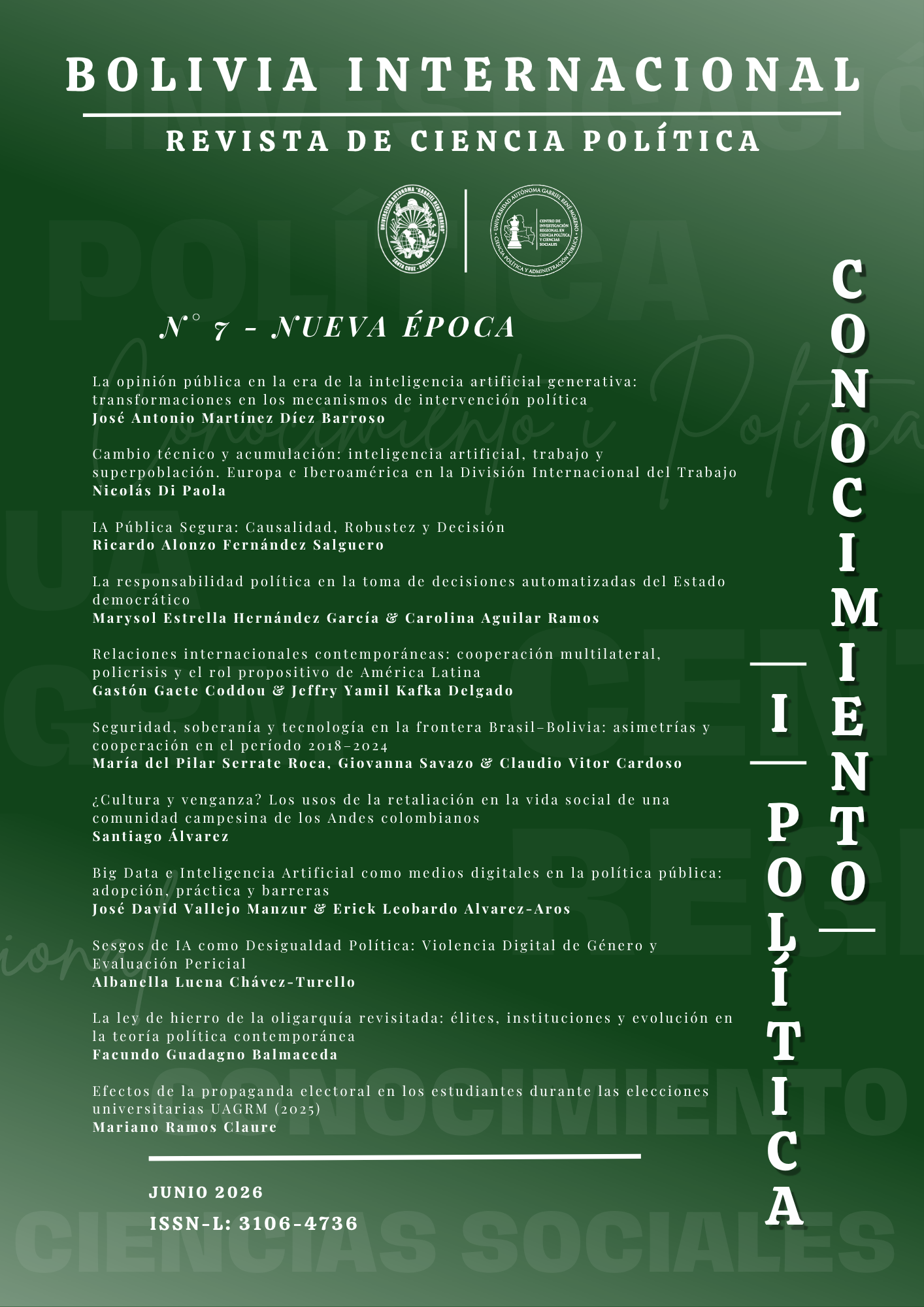
La ley de hierro de la oligarquía revisitada: élites, instituciones y evolución en la teoría política contemporánea
DOI:
https://doi.org/10.64480/cip.2026.n7.10Palabras clave:
oligarquía, élites, instituciones, democracia, teoría políticaResumen
La ley de hierro de la oligarquía, formulada por Robert Michels, ha sido tradicionalmente interpretada como una tesis sobre la inevitabilidad de la concentración del poder en organizaciones complejas. Este ensayo bibliográfico examina críticamente cómo la literatura contemporánea ha abordado —directa o indirectamente— este problema a través de tres enfoques principales: el institucionalismo político-económico, la teoría de la democracia de partidos y la antropología evolutiva. A partir del análisis comparativo de obras clave como Why Nations Fail (Acemoglu & Robinson, 2012), Ruling the Void (Mair, 2013), Governing the Commons (Ostrom, 1990) y Hierarchy in the Forest (Boehm, 1999), se argumenta que ninguna de estas tradiciones logra por sí sola explicar plenamente la persistencia de las élites. El trabajo propone una síntesis que incorpora limitaciones cognitivas, escala social y mecanismos evolutivos para reinterpretar la ley de Michels como una regularidad probabilística y no como una ley universal.
Descargas
Citas
Acemoglu, D., & Robinson, J. A. (2012). Why nations fail: The origins of power, prosperity, and poverty. Crown Business.
Boehm, C. (1999). Hierarchy in the forest: The evolution of egalitarian behavior. Harvard University Press.
Dunbar, R. I. M. (1992). Neocortex size as a constraint on group size in primates. Journal of Human Evolution, 22(6), 469–493. https://doi.org/10.1016/0047-2484(92)90081-J
Durkheim, É. (1893). De la division du travail social. Alcan.
Henrich, J. (2016). The secret of our success: How culture is driving human evolution, domesticating our species, and making us smarter. Princeton University Press.
Kahneman, D. (2011). Thinking, fast and slow. Farrar, Straus and Giroux.
Katz, R. S., & Mair, P. (1995). Changing models of party organization and party democracy: The emergence of the cartel party. Party Politics, 1(1), 5–28. https://doi.org/10.1177/1354068895001001001
Mair, P. (2013). Ruling the void: The hollowing of Western democracy. Verso.
Michels, R. (1911). Political parties: A sociological study of the oligarchical tendencies of modern democracy. Free Press. (Edición original publicada en 1911)
North, D. C. (1990). Institutions, institutional change and economic performance. Cambridge University Press.
Olson, M. (1965). The logic of collective action: Public goods and the theory of groups. Harvard University Press.
Ostrom, E. (1990). Governing the commons: The evolution of institutions for collective action. Cambridge University Press.
Ostrom, E. (2005). Understanding institutional diversity. Princeton University Press.
Pierson, P. (2000). Increasing returns, path dependence, and the study of politics. American Political Science Review, 94(2), 251–267. https://doi.org/10.2307/2586011
Simon, H. A. (1957). Administrative behavior: A study of decision-making processes in administrative organization (2nd ed.). Macmillan.
Stigler, G. J. (1971). The theory of economic regulation. The Bell Journal of Economics and Management Science, 2(1), 3–21. https://doi.org/10.2307/3003160
Tilly, C. (1990). Coercion, capital, and European states, AD 990–1990. Blackwell.
Tomasello, M. (2014). A natural history of human thinking. Harvard University Press.
Publicado
Cómo citar
Número
Sección
Licencia
Derechos de autor 2026 Facundo Guadagno Balmaceda

Esta obra está bajo una licencia internacional Creative Commons Atribución 4.0.
Los autores conservan sus derechos de autor y conceden a Conocimiento i política el derecho no exclusivo de primera publicación. Los artículos se publican bajo la licencia Creative Commons Atribución-NoComercial-SinDerivadas 4.0 Internacional (CC BY-NC-ND 4.0). Esta licencia permite copiar y redistribuir el material en cualquier medio o formato, siempre que se reconozca adecuadamente la autoría y la primera publicación en la revista, el uso no sea comercial y no se distribuya material modificado. Los autores pueden depositar y difundir la versión publicada en repositorios institucionales o temáticos, páginas personales y redes académicas, sin periodo de embargo, citando la publicación original e incluyendo su DOI o URL.


