
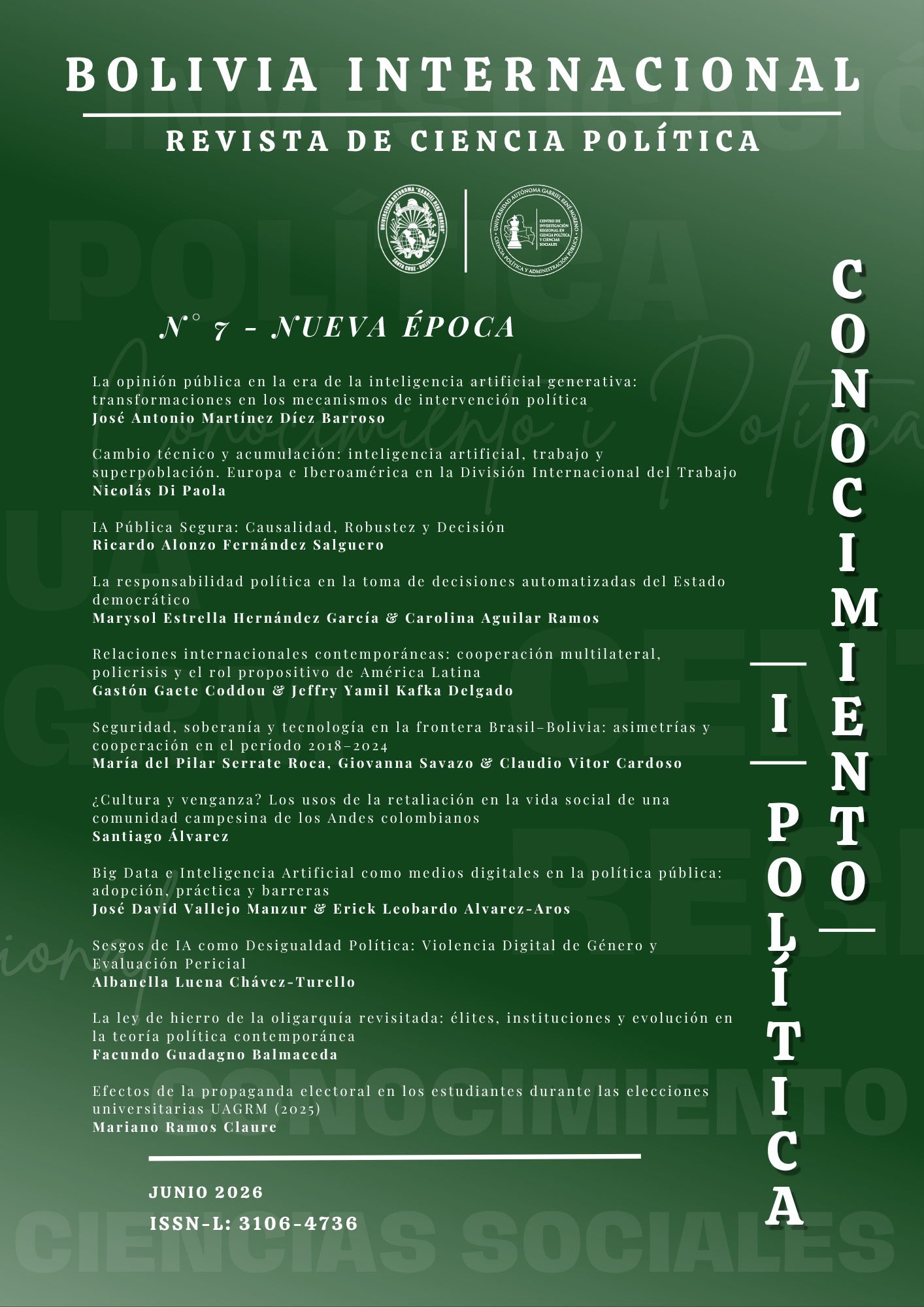
La opinión pública en la era de la inteligencia artificial generativa: Transformaciones en los mecanismos de intervención política
DOI:
https://doi.org/10.64480/cip.2026.n7.01Palabras clave:
Opinión pública, Inteligencia artificial, Redes sociales, Comunicación política, Desinformación, DemocraciaResumen
Este artículo analiza las transformaciones en los mecanismos de incidencia sobre la opinión pública a partir de la irrupción de la inteligencia artificial (IA) generativa. La investigación se sustenta en una revisión bibliográfica de carácter interpretativo, centrada en publicaciones académicas recientes localizadas en bases de datos indexadas, con el objetivo de identificar continuidades y rupturas respecto de las formas tradicionales de influencia mediática. En una primera parte, se examinan los enfoques clásicos de la opinión pública desarrollados en el campo de las ciencias políticas y sociales, destacando el papel de los medios de comunicación, las encuestas y los procesos deliberativos en la formación de las percepciones colectivas. Posteriormente, se analizan las transformaciones introducidas por las redes sociales y, de manera más reciente, por la IA generativa y los grandes modelos de lenguaje (LLM). Los resultados muestran que estas tecnologías han intensificado fenómenos como la personalización del contenido, la formación de “cámaras de eco”, la simulación de consenso mediante bots y la generación de contenido sintético, lo que incide en la configuración de la opinión pública contemporánea. En este contexto, se discuten los riesgos asociados a la manipulación de la percepción colectiva, la desinformación y el debilitamiento de los procesos deliberativos, así como sus posibles implicaciones para las democracias actuales.
Descargas
Citas
Allport, F. H. 1940. “Polls and the Science of Public Opinion.” The Public Opinion Quarterly 4 (2): 249-257.
Aral, S. 2021. The hype machine. Penguin Random House.
Argyle, L. P., Busby, E. C., Gubler, J. R., Lyman, A., Olcott, J., Pond, J., & Wingate, D. 2025. Testing theories of political persuasion using AI. Proceedings of the National Academy of Sciences, 122(18). https://doi.org/10.1073/pnas.2412815122
Ariza, L., & Ruiz, C. B. 2025. Inteligencia artificial en el sector público: Enfoques teóricos y propuestas para una gestión innovadora para América Latina. Gobierno y Administración Pública, 10, 119–134. https://doi.org/10.29393/GP10-9SPLA20009
Becker Castellaro, S., Carvalho, M., Fernández Gibaja, A., Grassi, A., Hammar, C., Müller, J., Pereira, L., Piaia, V., & Ruediger, M. A. 2025. Inteligencia artificial e integridad de la información: Experiencias latinoamericanas (Documento de política N.º 34). International IDEA. https://www.idea.int/publications/catalogue/html/inteligencia-artificial-e-integridad-de-la-informacion-experiencias
Bickerton, C. J., & Invernizzi Accetti, C. 2021. Technopopulism: The new logic of democratic politics. Oxford University Press. https://doi.org/10.1093/oso/9780198807766.001.0001
Bryce, J. 1888. The American Commonwealth. New York, Macmillan.
Bucher, T. 2018. If… then: Algorithmic power and politics. Oxford University Press.
Carrasco-Ahen, C. J., Castillo Arrosquipa, G., Palacios Ticona, G. S., & Sánchez-Córdova, M. 2025. Producción científica sobre inteligencia artificial en América Latina: Un análisis bibliométrico. EPISTEMUS, 19(38). https://doi.org/10.36790/epistemus.v19i38.457
Castells, M. 2009. Comunicación y Poder. Alianza Editorial.
Cave, D., Hoffman, S., Joske, A., Ryan, F., & Thomas, E. 2019. Mapping China’s technology giants. The Australian Strategic Policy Institute.
Centro de Estudios Estratégicos de Derecho de la Inteligencia Artificial (CEEDIA). 2026. Inicio. https://ceedia.org/
CEPAL. 2023. Inteligencia artificial en América Latina y el Caribe: desafíos, oportunidades y políticas públicas. https://repositorio.cepal.org/handle/11362/69210
Codina, L. 2020. Cómo hacer revisiones bibliográficas tradicionales o sistemáticas utilizando bases de datos académicas. Revista ORL, 11(2), 139–153. https://doi.org/10.14201/orl.22977
Coeckelbergh, M. 2024. Why AI undermines democracy and what to do about it. Polity Press.
Coeckelbergh, M. 2026. Technofascism: AI, Big Tech, and the new authoritarianism. AI & Society. https://doi.org/10.1007/s00146-026-02862-9
Cohen, B. 1963. The press and foreign policy. Princeton University Press.
Converse, P. E. 1964. “The Nature of Belief Systems in Mass Publics.” Ideology and Discontent. New York, The Free Press.
Converse, Philip E. 1970. “Attitudes and Non-Attitudes: Continuation of a Dialogue.” The Quantitative Analysis of Social Problems. Reading, Addison-Wesley.
Couldry, N. 2012. Media, Society, World: Social Theory and Digital Media Practice. London, Polity.
Criado, J. I. 2024. Inteligencia artificial en el sector público latinoamericano: Estudio comparado a partir de la Carta Iberoamericana de Inteligencia Artificial en la Administración Pública. Revista del CLAD Reforma y Democracia, 88, 116–143. https://doi.org/10.69733/clad.ryd.n88.a387
Dean, J. 2005. Communicative capitalism: Circulation and the foreclosure of politics. Cultural Politics, 1(1), 51–74. https://doi.org/10.2752/174321905778054845
Dewey, John. 1927. The Public and its Problems. New York, Holt
Doshi, J. A., Novacic, I., Fletcher, C., Borges, M., Zhong, E., Marino, M., Gan, J., Mager, S., Sprague, D. N., & Xia, M. 2024. Sleeper social bots: A new generation of AI disinformation bots are already a political threat. arXiv. https://doi.org/10.48550/arXiv.2408.12603
Elmas, T. 2023. Analyzing activity and suspension patterns of Twitter bots attacking Turkish Twitter trends by a longitudinal dataset. arXiv. https://doi.org/10.48550/arXiv.2304.07907
Estrada Merino, A. 2025. Inteligencia artificial: hacia una gobernanza ética. Acta Herediana, 68(2), 33–40. https://doi.org/10.20453/ah.v68i2.7505
Farahany, N. A. 2023. The battle for your brain. St. Martin’s Press.
Feldstein, S. 2019. The Global Expansion of AI Surveillance. Carnegie Endowment for International Pace.
Feldstein, S. 2023. The consequences of generative AI for democracy, governance and war. Survival. Global Politics and Strategy, 65(5), 117–142. https://doi.org/10.1080/00396338.2023.2261260
Ferrara, E.; Varol, O.; Davis, C.; Menczer, F. y Flammini, A. 2016. “El auge de los bots sociales”. Comunicaciones de la ACM, 59(7), 96-104.
García-Estévez, N., Ballesteros-Aguayo, L., & Colussi, J. 2025. Desinformación y manipulación de la opinión pública: Una revisión sistemática sobre astroturfing (2004–2024). Revista de Comunicación, 24(2), 159–181. https://doi.org/10.26441/RC24.2-2025-3988
García-Marzá, D., & Calvo, P. 2022. Democracia algorítmica: ¿un nuevo cambio estructural de la opinión pública? Isegoría, 67. https://doi.org/10.3989/isegoria.2022.67.17
García-Marzá, D., & Calvo, P. 2024. Algorithmic democracy: A critical perspective based on deliberative democracy. Springer.
Goldstein, J. A., Sastry, G., Musser, M., DiResta, R., Gentzel, M., & Sedova, K. 2023. Generative Language Models and Automated Influence Operations: Emerging Threats and Potential Mitigations. https://doi.org/10.48550/arXiv.2301.04246
Gorodnichenko, Y.; Pham, T. y Talavera, O. 2021. “Social Media, Sentiment and Public Opinions: Evidence from #Brexit and #USElection”. European Economic Review, 136. https://doi.org/10.3386/w24631
Guanche, J. C., Reyes, N., & Guoliang, L. 2025. Inteligencia artificial (IA) y competencias mediáticas, digitales, informacionales y comunicacionales en América Latina y el Caribe: Una perspectiva ética y crítica en la era algorítmica. Revista Latinoamericana de Comunicación, 159, 17–36. https://doi.org/10.16921/chasqui.v1i159.5219
Habermas, J. 1998. Facticidad y validez. Madrid, Trotta.
Habermas, J. 1987. Teoría de la acción comunicativa. Madrid, Taurus.
Hackenburg, K., & Margetts, H. 2024. Evaluating the persuasive influence of political microtargeting with large language models. Proceedings of the National Academy of Sciences, 121(24). https://doi.org/10.1073/pnas.2403116121
Han, B. C. 2022. Infocracy: Digitalization and the crisis of democracy. Polity.
Hao, K. 2025. Empire of AI. Inside the race for total domination. Penguin.
Hyska, M. 2025. The politics of past and future: Synthetic media, showing, and telling. Philosophical Studies, 182(1), 137–158. https://doi.org/10.1007/s11098-023-02062-x
Ibarreche, X., Martínez Elebi, C., & Di Lorenzo, C. 2025. Reconocimiento facial y tecnologías de vigilancia en América Latina: Casos, proveedores y dinámicas comerciales. AlSur. https://www.alsur.lat/sites/default/files/2025-07/Reporte%20reconocimiento%20facial.pdf
Jung, J., & Katz, R. 2025. Impacto económico de la inteligencia artificial en América Latina. Transformación tecnológica y rezago en materia de inversión y capacidades laborales. CEPAL. https://repositorio.cepal.org/server/api/core/bitstreams/954c64fe-197c-49f9-b118-0707cc6f8910/content
Kitchenham, B. 2004. Procedures for performing systematic reviews. Keele University. http://www.inf.ufsc.br/~aldo.vw/kitchenham.pdf
Kreiss, D., Lawrence, R. G., & McGregor, S. C. 2023. In their own words: Political practitioner accounts of the democratic implications of artificial intelligence. New Media & Society. https://doi.org/10.1177/146144482311605
Lagos, A. 2025. Latam-GPT: The free, open source, and collaborative AI of Latin America. WIRED. https://www.wired.com/story/latam-gpt-the-free-open-source-and-collaborative-ai-of-latin-america/
Larocca, N. 2025. Redes sociales llegan a 86 de cada 100 personas en América Latina. DPL News. https://dplnews.com/redes-sociales-llegan-a-86-de-cada-100-personas-en-america-latina/
Lippmann, W. 1922. Public Opinion. New York, Macmillan.
Lippmann, W. 1925. Phantom Public. A Sequel to "Public Opinion". Nueva York.
Liu, Y., Padmanabhan, B., & Viswanathan, S. 2025. What exactly is a deepfake? arXiv. https://doi.org/10.48550/arXiv.2510.22128
López del Castillo, F. L. 2024. Inteligencia artificial generativa: determinismo tecnológico o artefacto construido socialmente. Palabra Clave, 27(1). https://doi.org/10.5294/pacla.2024.27.1.9
López López, P. C., Maldonado, A. M., & Ribeiro, V. 2023. La desinformación en las democracias de América Latina y la península ibérica. Uru: Revista de Comunicación y Cultura. https://doi.org/10.32719/26312514.2023.8.5
Lowell, A. L. 1913. Public Opinion and Popular Government. New York, Longmans Green.
Marda, V. 2019. Inteligencia artificial: una perspectiva desde el Sur. América Latina en Movimiento. https://alainet.org/es/articulo/203490
McLeod, S. 2024. Doing a scoping review: A practical, step-by-step guide. ResearchGate. https://doi.org/10.13140/RG.2.2.23703.79528
Meikle, G. 2023. Deepfakes. Polity Press.
Moore, M. 2018. Democracy hacked: How technology is destabilising global politics. Oneworld.
Mora-Reyes, B. A., Drewyor, J. A., & Reyes-Angulo, A. A. 2025. Advancing equitable AI: Evaluating cultural expressiveness in LLMs for Latin American contexts. arXiv. https://doi.org/10.48550/arXiv.2511.04090
Nightingale, S. J., & Farid, H. 2022. AI-synthesized faces are indistinguishable from real faces and more trustworthy. Proceedings of the National Academy of Sciences, 119(8), e2120481119. https://doi.org/10.1073/pnas.2120481119
OECD. 2022. Uso estratégico y responsable de la inteligencia artificial en el sector público de América Latina y el Caribe. https://www.oecd.org/es/publications/uso-estrategico-y-responsable-de-la-inteligencia-artificial-en-el-sector-publico-de-america-latina-y-el-caribe_5b189cb4-es/full-report/component-6.html
Okoli, C., & Schabram, K. 2010. A Guide to Conducting a Systematic Literature Review of Information Systems Research. Communications of the Association for Information Systems, 37(43), 879-910. http://dx.doi.org/10.2139/ssrn.1954824
Page, B. I., Robert Y. Shapiro. 1992. The Rational Public. Fifty Years of Trends in Americans Policy Preferences. Chicago, The University of Chicago Press.
Pariser, E. 2011. The filter bubble: how the new personalized web is changing what we read and how we think. Penguin Books.
Pastor-Galindo, J., Zago, M., Nespoli, P., López Bernal, S., Huertas Celdrán, A., Gil Pérez, M., Ruipérez-Valiente, J. A., Martínez Pérez, G., & Gómez Mármol, F. 2020. Spotting political social bots in Twitter: A use case of the 2019 Spanish general election. arXiv. https://doi.org/10.48550/arXiv.2004.00931
Pawelec, M. 2022. Deepfakes and democracy (theory): How synthetic audio-visual media for disinformation and hate speech threaten core democratic functions. Digital Society, 1(2), 19. https://doi.org/10.1007/s44206-022-00010-6
Raj, P. 2025. The impact of deepfake technology on elections and democratic trust. Indian Journal of Law, 3(6), 56–64. https://doi.org/10.36676/ijl.v3.i6.137
Ranka, H., Surana, M., Kothari, N., Pariawala, V., Banerjee, P., Surve, A., Sankepally, S. R., Jain, R., Lalwani, J., & Mehta, S. S. 2024. Examining the implications of deepfakes for election integrity. arXiv. https://doi.org/10.48550/arXiv.2406.14290
Redacción AN. 2018, junio 20. Los bots y su influencia en la elección presidencial mexicana: Albert-László Barabási. Aristegui Noticias. https://aristeguinoticias.com/2006/mexico/los-bots-y-su-influencia-en-la-eleccion-presidencial-mexicana-albert-laszlo-barabasi/
Saura García, C. 2025. Synthetification of public opinion: Impacts on deliberative democracies. Ethics and Information Technology, 27(4), 1–14. https://doi.org/10.1007/s10676-025-09870-1
Schiff, K. J., Schiff, D. S., & Bueno, N. S. 2025. The liar’s dividend: Can politicians claim misinformation to evade accountability? American Political Science Review, 119(1), 71–90. https://doi.org/10.1017/S0003055423001454
Simchon, A., Edwards, M., & Lewandowsky, S. 2024. The persuasive effects of political microtargeting in the age of generative artificial intelligence. PNAS Nexus, 3(2). https://doi.org/10.1093/pnasnexus/pgae035
Snowden, E. 2019. Permanent record. Metropolitan Books.
Splichal, S. 2022. Datafication of public opinion and the public sphere: How extraction replaced expression of opinion. Anthem.
Woolley, S. 2023. Manufacturing consensus: Understanding propaganda in the era of automation and anonymity. Yale University Press.
Yang, K.-C.; Varol, O.; Davis, C. A.; Ferrara, E.; Flammini, A. y Menczer, F. 2019. “Arming the public with artificial intelligence to counter social bots”. Human Behavior & Emerging Technologies 1(1), 48-61. https://doi.org/10.1002/hbe2.115
Zaller, J. R. 1992. The Nature and Origins of Mass Opinion. Cambridge: Cambridge University Press.
Zuboff, S. 2019. The age of surveillance capitalism: The fight for The future at The new frontier of power. Profile Books.
Publicado
Cómo citar
Número
Sección
Licencia
Derechos de autor 2026 José Antonio Martínez Díez Barroso

Esta obra está bajo una licencia internacional Creative Commons Atribución 4.0.
Los autores conservan sus derechos de autor y conceden a Conocimiento i política el derecho no exclusivo de primera publicación. Los artículos se publican bajo la licencia Creative Commons Atribución-NoComercial-SinDerivadas 4.0 Internacional (CC BY-NC-ND 4.0). Esta licencia permite copiar y redistribuir el material en cualquier medio o formato, siempre que se reconozca adecuadamente la autoría y la primera publicación en la revista, el uso no sea comercial y no se distribuya material modificado. Los autores pueden depositar y difundir la versión publicada en repositorios institucionales o temáticos, páginas personales y redes académicas, sin periodo de embargo, citando la publicación original e incluyendo su DOI o URL.


