
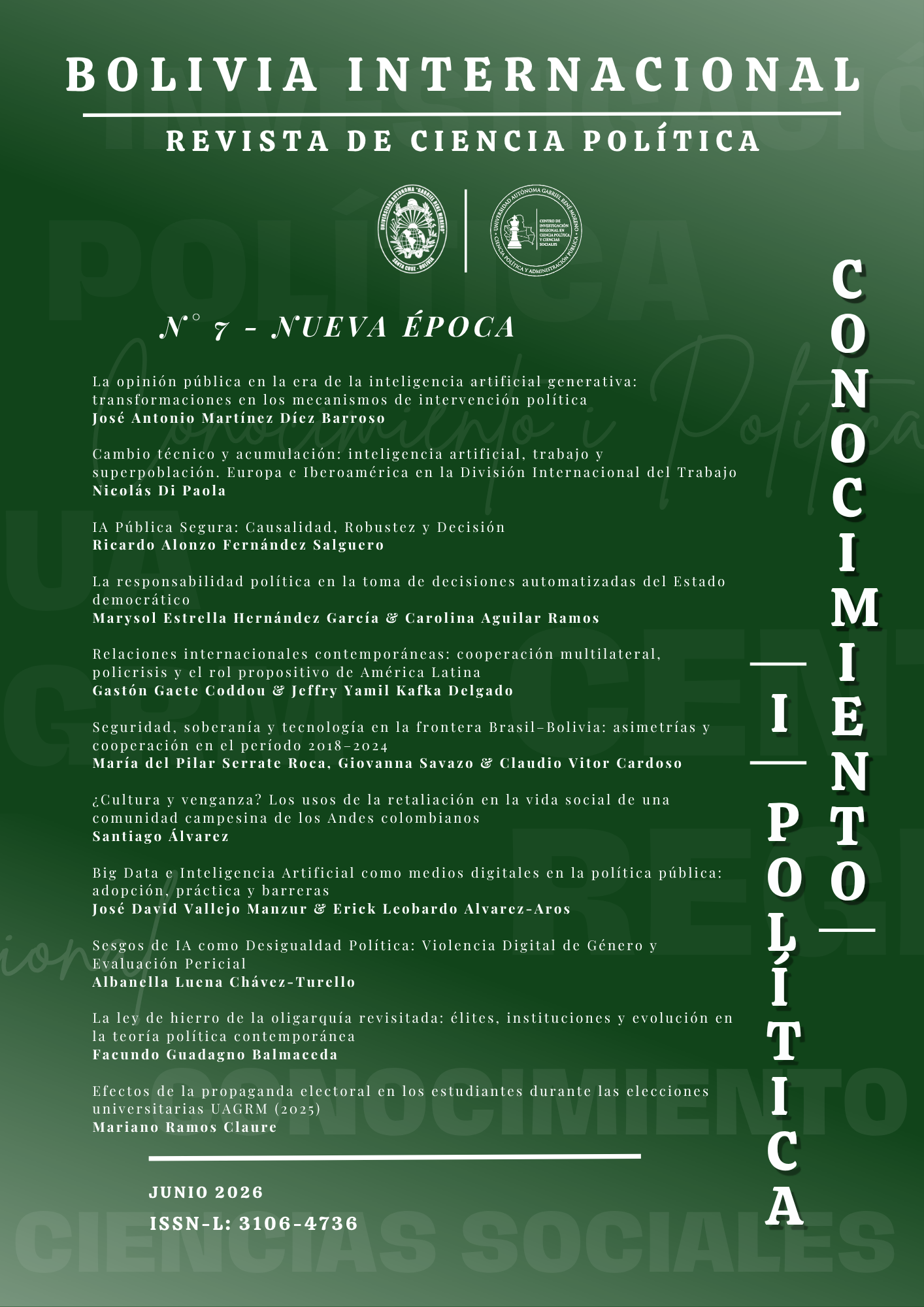
Big Data e Inteligencia Artificial como medios digitales en la política pública: adopción, práctica y barreras
DOI:
https://doi.org/10.64480/cip.2026.n7.08Palabras clave:
Políticas públicas, prospectiva, Big Data, Inteligencia artificial, adopción tecnológica y gobierno digital.Resumen
El presente estudio analiza el estado del arte en el uso de Big Data e inteligencia artificial (IA) en la prospectiva de políticas públicas, destacando su relevancia como herramientas clave para anticipar escenarios futuros, optimizar recursos y diseñar soluciones adaptativas en contextos gubernamentales. El objetivo principal es comprender cómo estas tecnologías están transformando la capacidad de los gobiernos para abordar problemas complejos de manera estratégica y eficiente.
Mediante una metodología basada en una exhaustiva revisión de literatura, se identificaron modelos de adopción tecnológica, aplicaciones prácticas y barreras en su implementación. Los modelos analizados, como el Modelo de Difusión de Innovaciones, el Modelo de Madurez Tecnológica y el Modelo UTAUT, ofrecen perspectivas sobre los factores que determinan la integración de estas tecnologías en la administración pública. Además, se documentaron aplicaciones prácticas en ámbitos como la movilidad urbana, la salud pública y la sostenibilidad ambiental, con casos destacados, donde estas herramientas han permitido diseñar políticas más precisas y efectivas.
Entre las barreras identificadas destacan la falta de interoperabilidad tecnológica, la carencia de personal capacitado y los desafíos en la infraestructura tecnológica. Las conclusiones subrayan la necesidad de fomentar la interoperabilidad entre sistemas, fortalecer la capacitación en el sector público y explorar nuevos contextos de aplicación. Este análisis aporta una base sólida para el diseño
Descargas
Citas
Amaral, S., Santos, J. R., & Martins, M. 2020. Monitoring deforestation in the Amazon using satellite imagery and machine learning. Journal of Environmental Science 58(3): 220–231.
Angwin, J., Larson, J., Mattu, S., & Kirchner, L. 2016. Machine bias: There’s software used across the country to predict future criminals. And it’s biased against blacks. ProPublica. https://www.propublica.org
Baller, S., Dutta, S., & Lanvin, B. 2016. The global information technology report 2016: Innovating in the digital economy. World Economic Forum.
Batty, M. 2013. Big data, smart cities and city planning. Dialogues in Human Geography 3(3): 274–279. https://doi.org/10.1177/2043820613513390
Breiman, L. 2001. Random forests. Machine Learning, 45(1): 5–32. https://doi.org/10.1023/A:1010933404324
Choi, H. & Varian, H. 2012. Predicting the present with Google Trends. Economic Record 88(s1): 2–9.
Crawford, K., Dobson, K. & MacDonald, F. 2021. Data colonialism and the limits of AI ethics. Big Data & Society 8(2). https://doi.org/10.1177/20539517211017227
Das, R., & Zhang, Z. 2019. AI and big data in healthcare: The next frontier for innovation. Journal of Healthcare Informatics 12(3): 45–61.
Devlin, J., Chang, M.-W., Lee, K. & Toutanova, K. 2019. BERT: Pre-training of deep bidirectional transformers for language understanding. Proceedings of the 2019 Conference of the North American Chapter of the Association for Computational Linguistics 1(1): 4171–4186. https://doi.org/10.18653/v1/N19-1423
Gartner. 2019. Hype cycle for emerging technologies. Gartner Research.
Goodfellow, I., Bengio, Y. & Courville, A. 2016. Deep learning. MIT Press.
Hardoon, D. & Shmueli, G. 2013. Getting started with business analytics: Insightful decision-making. CRC Press.
Howard, P. N. & Kollanyi, B. 2016. Bots, social media, and the public discourse: Miscommunication in the age of automation. Political Communication 33(1): 1–10. https://doi.org/10.1080/10584609.2016.1224894
Hyndman, R. J. & Athanasopoulos, G. 2018. Forecasting: Principles and practice (2nd ed.). OTexts.
Jurafsky, D. & Martin, J. H. 2022. Speech and language processing (3rd ed.). Pearson.
Kitchin, R. 2014. The data revolution: Big data, open data, data infrastructures & their consequences. SAGE Publications.
Kostka, G. 2019. China’s social credit systems and public opinion: Explaining high levels of approval. New Media & Society 21(7): 1565–1593.
Laney, D. 2001. 3D data management: Controlling data volume, velocity and variety. META Group Research Note.
Liu, B. 2020. Sentiment analysis: Mining opinions, sentiments, and emotions (2nd ed.). Cambridge University Press.
Manyika, J., Chui, M., Brown, B., Bughin, J., Dobbs, R., Roxburgh, C. & Byers, A. H. 2011. Big data: The next frontier for innovation, competition, and productivity. McKinsey Global Institute.
Mayer-Schönberger, V. & Cukier, K. 2013. Big data: A revolution that will transform how we live, work, and think. Houghton Mifflin Harcourt.
Mittelstadt, B. D., Allo, P., Taddeo, M., Wachter, S. & Floridi, L. 2016. The ethics of algorithms: Mapping the debate. Big Data & Society 3(2): 1–21. https://doi.org/10.1177/2053951716679679
Muralidharan, K., Niehaus, P. & Sukhtankar, S. 2016. Building state capacity: Evidence from biometric smartcards in India. American Economic Review 106(10): 2895–2929. https://doi.org/10.1257/aer.20141346
North, M. J. & Macal, C. M. 2007. Managing business complexity: Discovering strategic solutions with agent-based modeling and simulation. Oxford University Press.
OECD. 2019. The path to becoming a data-driven public sector. OECD Digital Government Studies.
Pearl, J. 2009. Causality: Models, reasoning, and inference (2nd ed.). Cambridge University Press.
Rogers, E. M. 2003. Diffusion of innovations (5th ed.). Free Press.
Toots, M., McBride, K., Kalvet, T. & Krimmer, R. 2017. Open data as enabler of public service co-creation: Exploring the drivers and barriers. Information Polity 22(3): 231–245.
Venkatesh, V., Morris, M. G., Davis, G. B. & Davis, F. D. 2003. User acceptance of information technology: Toward a unified view. MIS Quarterly 27(3): 425–478.
White, T. 2015. Hadoop: The definitive guide (4th ed.). O’Reilly Media.
Zaharia, M., Chowdhury, M., Franklin, M. J., Shenker, S. & Stoica, I. 2016. Spark: Cluster computing with working sets. USENIX Conference on Networked Systems Design and Implementation.
Zhou, X., Zafarani, R., Shu, K. & Liu, H. 2020. Fake news: Fundamental theories, detection strategies, and challenges. Proceedings of the 26th ACM SIGKDD International Conference on Knowledge Discovery and Data Mining 3205–3206. https://doi.org/10.1145/3394486.3406468
Publicado
Cómo citar
Número
Sección
Licencia
Derechos de autor 2026 José David Vallejo Manzur, Erick Leobardo Alvarez-Aros

Esta obra está bajo una licencia internacional Creative Commons Atribución 4.0.
Los autores conservan sus derechos de autor y conceden a Conocimiento i política el derecho no exclusivo de primera publicación. Los artículos se publican bajo la licencia Creative Commons Atribución-NoComercial-SinDerivadas 4.0 Internacional (CC BY-NC-ND 4.0). Esta licencia permite copiar y redistribuir el material en cualquier medio o formato, siempre que se reconozca adecuadamente la autoría y la primera publicación en la revista, el uso no sea comercial y no se distribuya material modificado. Los autores pueden depositar y difundir la versión publicada en repositorios institucionales o temáticos, páginas personales y redes académicas, sin periodo de embargo, citando la publicación original e incluyendo su DOI o URL.


